

Hurricane-Proof Roofing: Materials, Codes, and Upgrades That Protect Florida Homes
Hurricane-Proof Roofing
Florida homeowners learned a hard lesson from Hurricane Ian in 2022. Roofs that met bare minimum code still failed under Category 4 winds. Shingles peeled off in sheets, underlayment tore away, and water poured into attics within minutes.
The 2026 hurricane season is approaching, and the question is the same one homeowners across Sarasota County have asked every year since: what does it take to build a hurricane proof roof that holds through a real storm? The answer goes beyond picking the right shingle color. It starts with materials, fastening methods, and code-compliant upgrades that work together as a system. If you are planning a roof installation or replacement before June, this guide covers everything you need to make that decision.
A Sarasota roofing contractor familiar with local wind zones and permitting is your best resource for site-specific recommendations. Here is what every Florida homeowner should understand about hurricane-rated roofing in 2026.
How Florida Building Code Defines Wind-Resistant Roofing
Florida does not use a single wind standard statewide. The code divides the state into two main zones based on hurricane risk. The Wind-Borne Debris Region, or WBDR, covers most of the state and applies where design wind speeds start at 110 mph. The High-Velocity Hurricane Zone, or HVHZ, covers Miami-Dade and Broward counties with the strictest requirements in the nation.
Sarasota County falls within the WBDR. That means every roofing product used on your home must meet specific uplift and wind-resistance testing under ASTM D3161 and ASTM D7158. Shingles must carry a Class H rating to resist uplift in winds up to 150 mph.
The Florida Building Code, 8th Edition, took effect in late 2023 and remains the standard for 2026 permits. Several updates in this edition affect homeowners directly.
Nail penetration and deck attachment
The code now requires ring-shank nails for attaching roof decking to trusses. Standard smooth-shank nails pull out more easily under sustained wind pressure. Ring-shank nails grip the wood fibers and resist withdrawal far better. The minimum nail penetration through sheathing changed from 3/16 inch to 1/8 inch, aligning planks and plywood to a single standard.
For shingle attachment, the code requires at least four nails per shingle strip outside the HVHZ. Many contractors in Sarasota install six nails per shingle as standard practice because manufacturers require it for high-wind warranty coverage. Those two extra nails can mean the difference between a shingle that holds and one that peels during a storm.
The 25 percent replacement rule
If you replace more than 25 percent of your total roof area within any 12-month period, the entire roof must be brought up to current code. Partial repairs can trigger a full code-upgrade requirement, so it pays to plan ahead.
Underlayment requirements
Florida code requires a minimum of ASTM D226 Type II (#30 felt) or equivalent synthetic underlayment across the full roof deck. In addition, self-adhering modified bitumen membrane must cover all valleys, eaves, and other high-risk areas. This underlayment layer acts as your secondary water barrier, the backup system that keeps water out of your home if the shingles or tiles fail.
Impact-Rated Materials Compared: Metal, Tile, and Architectural Shingles
Choosing a roofing material in Florida is a performance decision first and a style decision second. Each material handles wind, impact, and water differently.
Metal standing seam
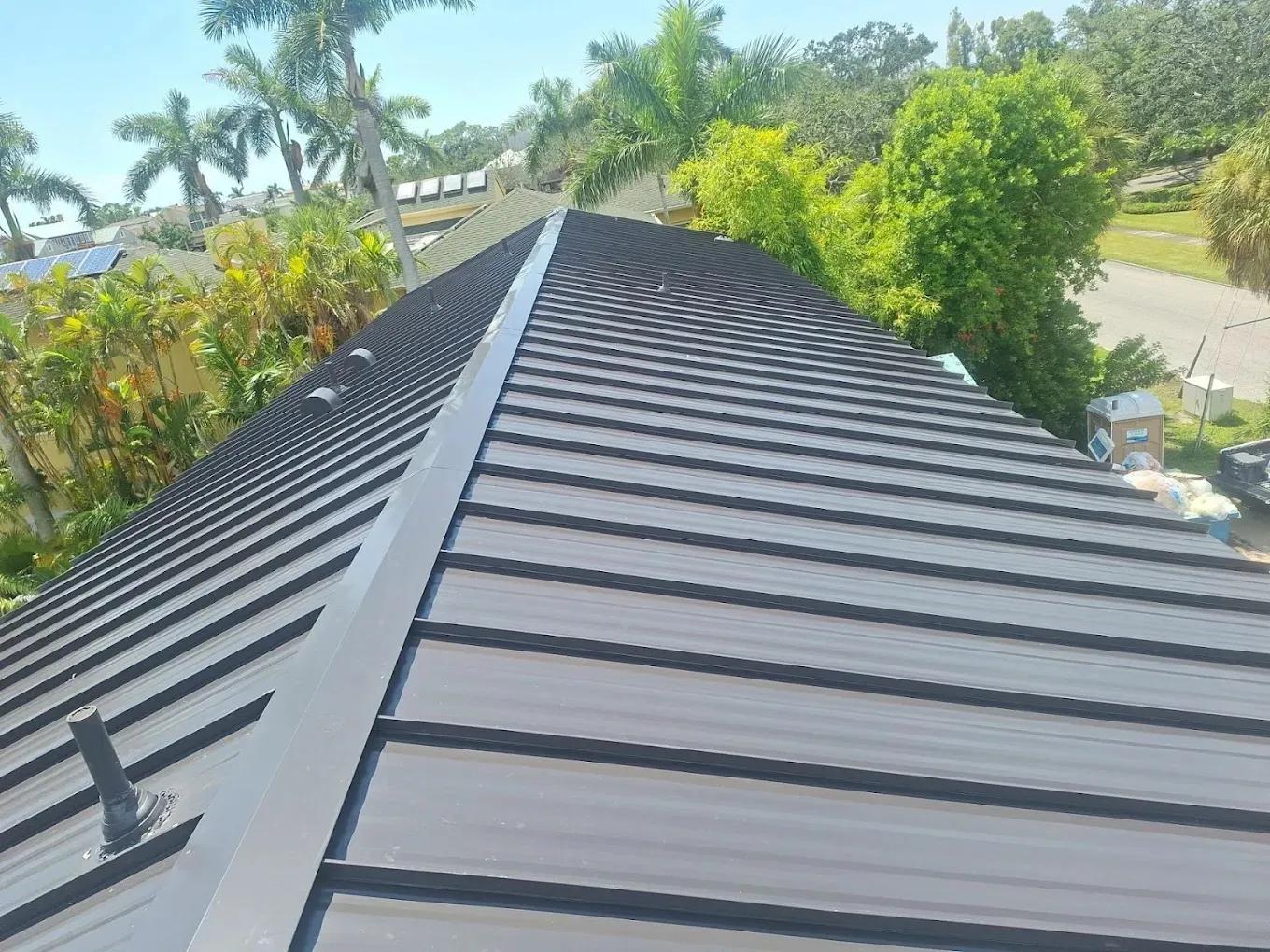
Standing seam metal roofing is one of the strongest options for hurricane zones. The panels interlock along raised seams, creating a continuous surface with very few gaps for wind to exploit. Most standing seam systems carry wind ratings between 140 and 180 mph, which covers Category 4 and some Category 5 events.
Metal is also lightweight at about 1.6 pounds per square foot, which puts less lateral stress on the wall structure during a storm. The tradeoff is cost. Metal roofing runs higher than asphalt shingles in both material and labor. But a metal roof can last 40 to 50 years with minimal maintenance, compared to 15 to 25 years for shingles.
Concrete and clay tile
Tile roofing is a familiar sight across Sarasota and the broader Gulf Coast. Concrete tiles can withstand winds up to 150 mph when installed with proper mechanical fasteners. Clay tiles handle winds up to 130 mph. Both materials resist UV degradation and hold up well against Florida's intense sun.
The weight of tile, around 9 to 10 pounds per square foot, helps resist uplift. But that same weight becomes a liability if tiles break loose during a storm. Proper fastening with screws, nails, and foam adhesive is essential to keep tiles anchored. Tile roofs also require a reinforced deck structure, which makes them a poor fit for older homes framed for lighter materials.
Architectural shingles with hurricane clips
Architectural shingles, also called dimensional or laminated shingles, are thicker and heavier than standard three-tab shingles. Quality architectural shingles carry wind ratings between 110 and 130 mph. Some premium products, like the GAF Timberline UHDZ line, offer unlimited wind-speed warranties for 15 years when installed to specification.
The key to making shingles perform in a hurricane is the complete assembly: ring-shank nails at six per shingle, proper starter strip adhesion at the eaves, sealed underlayment beneath, and hurricane straps connecting the deck to the wall structure. Without that full system, even a 130 mph-rated shingle can fail.
Shingles remain the most affordable option and allow for faster installation and easier post-storm repairs.
What Hurricane Straps and Secondary Water Barriers Actually Do
Two terms come up repeatedly in Florida roofing conversations, and both appear on the wind mitigation inspection form that determines your insurance discounts.
Hurricane straps
Hurricane straps, sometimes called hurricane clips or wind clips, are metal connectors that tie the roof structure to the top of the exterior walls. They create what engineers call a continuous load path, a chain of connections running from the roof down through the walls to the foundation.
Older Florida homes, especially those built before the 2002 code overhaul, often have minimal roof-to-wall connections. Some rely on nothing more than toenailed joints. In a Category 3 storm with sustained winds above 111 mph, toenailed connections can fail and the entire roof can lift off the walls.
When you replace a roof in Sarasota County, the building code may require you to retrofit hurricane straps if the existing connections do not meet current standards. This is one of the most cost-effective upgrades a homeowner can make, both for safety and for insurance savings.
Secondary water barrier
The secondary water barrier, or SWB, is a waterproof membrane applied directly to the roof deck beneath the primary underlayment and roofing material. If the shingles, tiles, or panels blow off during a storm, the SWB keeps water from reaching the interior of the home.
Self-adhering modified bitumen sheets are the most common SWB material. Some contractors apply them across the full deck, while others focus on the perimeter, valleys, and penetrations.
Having an SWB documented on your wind mitigation inspection qualifies you for a specific insurance credit. For homes in Sarasota County, where premiums have climbed since Hurricane Ian, that credit can offset a meaningful portion of your annual cost.
How a Wind-Mitigation Roof Lowers Insurance Premiums in Sarasota County
Florida law requires insurance companies to offer premium discounts for homes with documented wind mitigation features. The process starts with a certified wind mitigation inspection, which costs between $75 and $150 in the Sarasota area. The inspector fills out form OIR-B1-1802, which evaluates six areas of your home.
Those six areas are roof covering type, roof deck attachment method, roof-to-wall connection type, opening protection (windows and doors), roof shape or geometry, and secondary water resistance. Each area that meets or exceeds the qualifying standard earns a separate credit on the windstorm portion of your premium.
The savings vary by insurer and by how many features your home qualifies for. On average, Florida homeowners save between $100 and $600 per year. Some households report discounts of 30 to 40 percent on the windstorm portion of their premium. A roof replacement that includes upgraded deck nailing, hurricane straps, and an SWB can qualify your home for credits across multiple categories at once.
Hip roofs earn a geometry credit because their sloped-on-all-sides design handles uplift pressure better than gable roofs. If your home has a gable roof, reinforcing the gable ends with bracing can improve your wind mitigation score.
In 2025, Florida expanded the My Safe Florida Home program with $280 million in new funding to help homeowners afford wind mitigation upgrades. The program offers matching grants, which means you may be able to offset part of the cost of a new roof or retrofit. Wind mitigation inspection reports remain valid for five years.
Roof Shape and Design Factors That Affect Hurricane Performance
Material and fastening get most of the attention, but roof geometry plays a large role in storm survival.
Hip roofs, which slope inward from all four sides, perform better in wind tunnel testing than gable roofs. The sloped surfaces deflect wind rather than catching it. Studies show hip roofs experience up to 40 percent less wind pressure than comparable gable roofs.
Roof pitch matters too. A moderate pitch around 30 degrees, roughly a 7:12 slope, tested best for wind resistance. Overhangs should be kept under 20 inches because long overhangs act like wings, catching uplift and transferring stress to the fascia and rafter tails.
When to Schedule Your Roof Upgrade Before the 2026 Season
Hurricane season runs from June 1 through November 30. Permitting, material lead times, and contractor schedules in Sarasota County mean a typical roof replacement takes four to eight weeks from contract signing to final inspection. If you want your new roof installed and inspected before the season starts, the window for scheduling is narrowing.
Start by getting a professional roof inspection to assess your current system. A qualified inspector can identify whether your deck nailing, straps, and underlayment meet current code, or whether a full replacement makes more sense than patchwork repairs.
If your existing roof is more than 15 years old, has visible storm damage, or was installed before the 2002 code updates, a replacement with current materials and methods will give you the strongest protection. It will also position your home for the maximum wind mitigation insurance credits.
Florida's building codes set a strong baseline. But a roof that just meets code gives you the minimum level of protection, not the best. The difference often comes down to details: two extra nails per shingle, full-deck SWB coverage instead of perimeter only, and strap connections at every truss rather than every other one. Those details add up when a Category 3 storm stalls over the coast.